
Sand Casting: A Timeless Manufacturing Process Shaping Modern Industry
Al-Tawheed Engineering LLC
In an era where advanced manufacturing technologies such as die-casting and additive manufacturing dominate industrial headlines, sand casting remains a cornerstone of the metal manufacturing world. For over 3,000 years, this versatile process has been used to produce complex metal components for applications ranging from automotive and aerospace to heavy machinery and energy equipment.
Despite its ancient roots, modern sand casting integrates cutting-edge techniques, improved materials, and automated systems to achieve the precision and efficiency demanded by today’s industries. It continues to offer unparalleled flexibility — enabling manufacturers to produce everything from small intricate parts to massive industrial castings with remarkable cost-effectiveness.
This article explores the sand casting process, its advantages, applications, and latest trends, demonstrating why it remains one of the most trusted and adaptable metal casting methods in modern manufacturing.
What Is Sand Casting?
Sand casting is a metal casting process in which molten metal is poured into a sand mold cavity formed from a pattern of the desired part. Once the metal solidifies, the sand mold is broken away, leaving behind the finished casting. The process is known for its simplicity, scalability, and ability to create complex geometries with a wide range of metals.

Key Materials Used in Sand Casting
- Molding Sand: Usually a mixture of silica sand, clay (bentonite), and water, providing strength and refractoriness.
- Pattern Material: Typically made from wood, plastic, or metal — depending on production volume.
- Core Material: Used when hollow or intricate internal cavities are needed within the part.
- Metals Cast: Aluminum, iron, steel, bronze, brass, and magnesium are the most common.
This combination of flexible materials and proven methodology makes sand casting suitable for both prototype development and high-volume production.
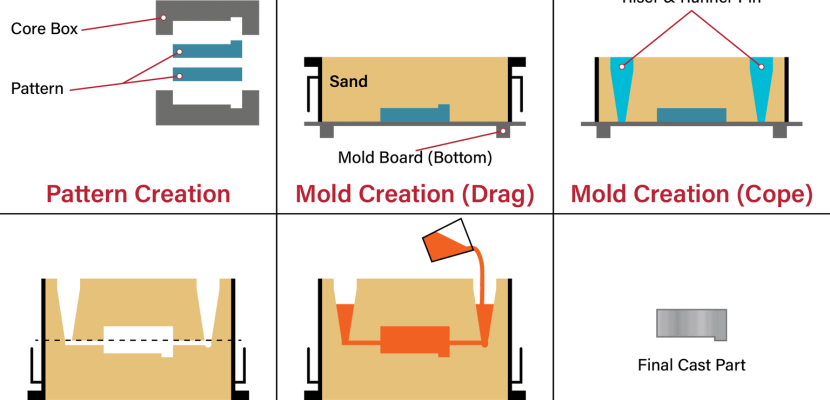
The Sand Casting Process: Step-by-Step Overview
- Pattern Creation
A pattern representing the shape of the final component is designed and fabricated. This pattern includes allowances for shrinkage, machining, and draft to ensure dimensional accuracy after casting.
- Mold Preparation
The pattern is placed inside a mold box (flask) and surrounded by a special molding sand mixture. The sand is compacted tightly around the pattern to form a cavity. For parts requiring internal voids, cores are inserted before closing the mold.
- Melting and Pouring
The selected metal is melted in a furnace — typically an induction, cupola, or electric arc furnace. Once it reaches the desired temperature, the molten metal is carefully poured into the mold through a gating system, which controls the metal flow and minimizes turbulence.
- Cooling and Solidification
After pouring, the metal cools and solidifies within the sand mold. Cooling time depends on the metal type, casting size, and wall thickness.
- Shakeout and Cleaning
Once the casting has solidified, the mold is broken apart (a process called shakeout) to remove the sand. The casting then undergoes cleaning operations, including shot blasting, grinding, and trimming of excess material.
- Inspection and Finishing
Dimensional accuracy, surface quality, and structural integrity are verified through quality inspections using visual checks, X-ray analysis, or non-destructive testing (NDT). Additional machining may be performed to meet precise specifications.
Advantages of Sand Casting
- Design Flexibility
Sand casting supports intricate geometries, complex cores, and a wide range of part sizes — from a few grams to several tons.
- Cost-Effectiveness
Unlike die casting or investment casting, sand casting requires minimal tooling investment, making it ideal for low-to-medium production runs and large components.
- Material Versatility
Almost any metal that can be melted can be sand cast — including aluminum, iron, steel, and bronze — providing excellent adaptability across industries.
- Scalability
From prototype to full production, sand casting can easily scale with project requirements, reducing lead times and enabling faster market delivery.
- Repair and Reusability
Patterns and molds can be easily modified or repaired, and molding sand can often be reclaimed and reused, promoting sustainability in production.
Applications of Sand Casting Across Industries
- Automotive and Transportation
Sand casting is used to produce engine blocks, manifolds, brackets, and gearbox housings. Its ability to handle complex designs and large parts makes it an ideal choice for automotive applications.
- Aerospace and Defense
Precision sand castings are used for turbine components, housings, and support structures, where strength and weight optimization are critical.
- Energy and Power Generation
From turbine casings to pump impellers, sand casting serves the power and energy sectors where heavy-duty, corrosion-resistant parts are required.
- Industrial Machinery
Sand casting provides durable components for compressors, gearboxes, agricultural equipment, and construction machinery — all demanding robust performance.
- Marine and Oil & Gas
The process is used to produce corrosion-resistant valves, propellers, and fittings, essential for offshore and marine operations.
Modern Advancements in Sand Casting Technology
Although the principles of sand casting remain traditional, technological innovations are revolutionizing the process:
- 1. 3D Printed Sand Molds
Additive manufacturing allows the creation of complex molds and cores directly from CAD data, reducing tooling time and enhancing accuracy.
- Automation and Robotics
Modern foundries use robotic pouring systems and automated mold handling, ensuring consistent quality and worker safety.
- Simulation Software
Casting simulation tools now predict metal flow, solidification, and defect formation — helping engineers optimize designs before production begins.
- Sustainable Sand Reclamation
Advanced sand reclamation systems reduce waste and minimize environmental impact, aligning manufacturing with modern sustainability goals.
Conclusion: The Continued Strength of Sand Casting in Modern Manufacturing
From automotive engines to power plant turbines, sand casting continues to shape the backbone of industrial manufacturing. Its combination of flexibility, scalability, and cost efficiency ensures its relevance even as advanced manufacturing techniques evolve.
By integrating modern automation, 3D printing, and simulation technologies, sand casting offers even greater precision and sustainability making it a future-ready solution for diverse industrial needs.