
Introduction: Why CNC Milling Matters in Today’s Manufacturing World
In today’s fast-paced manufacturing landscape, precision, efficiency, and consistency are no longer optional; they are essential. Among the many advanced machining technologies shaping modern production, CNC milling stands out as one of the most versatile and widely used manufacturing processes. From aerospace components to medical implants and automotive parts, CNC milling plays a critical role in producing complex, high-accuracy components across industries.
CNC (Computer Numerical Control) milling has transformed traditional milling operations into highly automated, repeatable, and data-driven processes. By integrating advanced software, multi-axis motion, and intelligent automation, CNC milling machines enable manufacturers to meet tight tolerances, reduce lead times, and scale production efficiently. As Industry 4.0 continues to evolve, CNC milling remains a foundational pillar of precision engineering.
What Is CNC Milling?
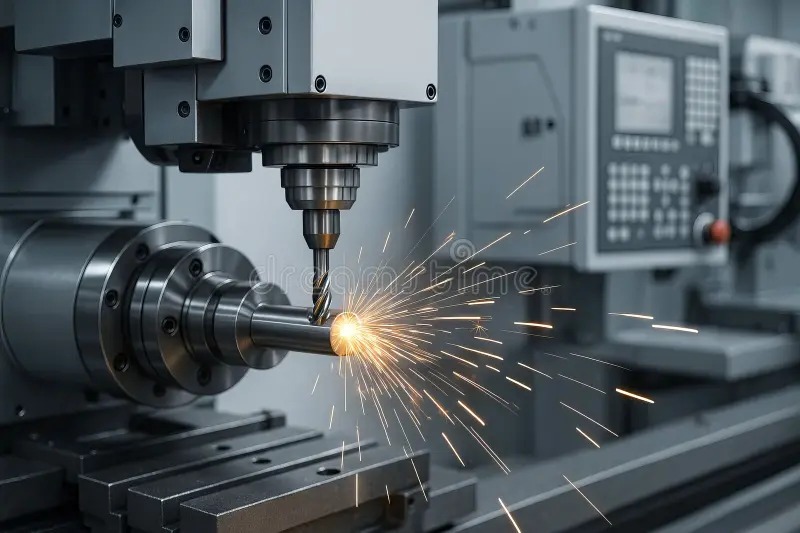
CNC milling is a subtractive manufacturing process in which a computer-controlled machine removes material from a solid workpiece using rotating cutting tools. Unlike CNC turning where the workpiece rotates in CNC milling, the cutting tool rotates while the workpiece remains stationary or moves along multiple axes.
The machine follows programmed instructions written in G-code, which precisely control tool movement, spindle speed, feed rate, and depth of cut. This automation allows CNC milling machines to produce complex geometries, slots, pockets, contours, and detailed features with exceptional accuracy.
Because of its flexibility, CNC milling is suitable for both prototyping and high-volume production, making it one of the most important machining processes in modern manufacturing.
Key Components of a CNC Milling Machine
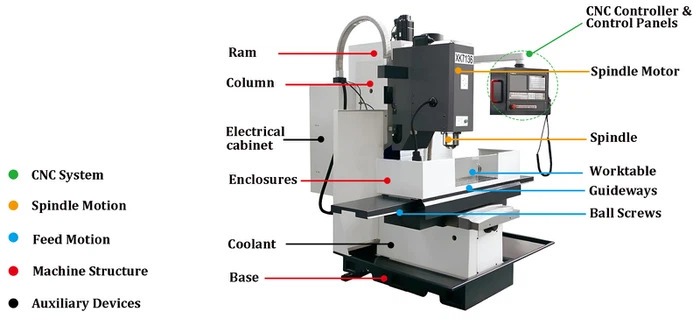
The performance and accuracy of a CNC milling machine depend on several core components:
1. Spindle
The spindle holds and rotates the cutting tool at controlled speeds. High-speed spindles are essential for achieving smooth surface finishes and efficient material removal.
2. Cutting Tools
End mills, face mills, drills, and specialty cutters are used depending on the operation. Tool selection directly affects surface finish, accuracy, and cycle time.
3. Worktable
The worktable securely holds the workpiece and moves along programmed axes to position the material accurately during machining.
4. CNC Controller
The controller interprets G-code instructions and coordinates machine movements with micron-level precision.
5. Machine Frame and Guides
A rigid structure minimizes vibration, ensuring dimensional accuracy and long tool life.
Types of CNC Milling Machines
Different manufacturing requirements call for different CNC milling configurations:
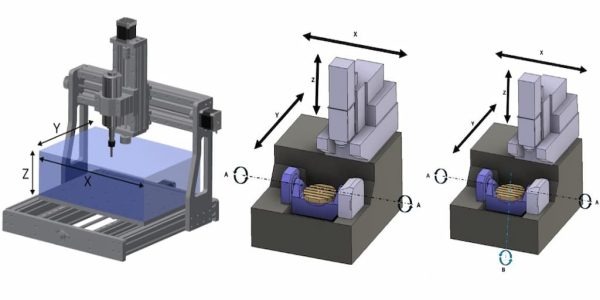
1. 3-Axis CNC Milling Machine
The most common type, operating along the X, Y, and Z axes. It is ideal for flat surfaces, slots, and simple geometries.
2. 4-Axis CNC Milling Machine
Adds a rotary axis, allowing the workpiece to rotate. This reduces setup time and enables machining on multiple sides.
3. 5-Axis CNC Milling Machine
Offers simultaneous movement along five axes, making it possible to machine highly complex parts in a single setup. Widely used in aerospace and medical manufacturing.
4. Vertical vs. Horizontal Milling Machines
Vertical machines are popular for general machining, while horizontal machines excel in high-volume production and heavy material removal.
Materials Commonly Used in CNC Milling
CNC milling is compatible with a wide range of materials, making it extremely versatile.
Metals
- Aluminum (lightweight and machinable)
- Stainless steel (corrosion-resistant and strong)
- Carbon steel (cost-effective)
- Brass and copper (excellent conductivity)
- Titanium (high strength-to-weight ratio)
Plastics
- ABS
- Nylon
- Polycarbonate
- PEEK
- Acrylic
High-Performance Alloys
- Inconel
- Tool steel
- Aerospace-grade alloys
Material selection depends on mechanical requirements, operating environment, and cost considerations.
CNC Milling Process: Step-by-Step Overview
- CAD Design
Engineers create a 3D model of the part using CAD software, defining geometry and tolerances. - CAM Programming
The design is converted into tool paths and G-code using CAM software. - Machine Setup
The workpiece is clamped to the table, tools are loaded, and offsets are set. - Machining Operation
The CNC milling machine removes material according to the programmed instructions. - Inspection and Finishing
Parts are inspected using precision measuring tools, and secondary finishing may be applied if required.
Advantages of CNC Milling
- High Precision: Capable of achieving tight tolerances for critical applications
- Repeatability: Consistent results across large production runs
- Complex Geometry: Easily machines intricate shapes and contours
- Reduced Lead Time: Faster production compared to manual machining
- Automation: Minimizes human error and labor dependency
Applications of CNC Milling Across Industries
- Automotive Industry
Engine blocks, brackets, transmission components, and molds.
- Aerospace Industry
Structural components, turbine parts, and precision housings.
- Medical Industry
Surgical instruments, implants, and orthopedic components.
- Electronics Industry
Enclosures, connectors, heat sinks, and precision frames.
- Industrial Equipment
Fixtures, tooling plates, and custom machine parts.
Modern Advancements in CNC Milling Technology
Recent innovations continue to enhance CNC milling capabilities:
- 5-Axis Machining: Reduces setups and increases accuracy
- High-Speed Machining: Improves surface finish and productivity
- Automation & Robotics: Enables lights-out manufacturing
- Smart Monitoring & IoT: Supports predictive maintenance
- Energy-Efficient Systems: Reduces power consumption and waste
Conclusion: CNC Milling as a Pillar of Modern Manufacturing
CNC milling remains one of the most powerful and versatile manufacturing technologies available today. Its ability to combine precision, automation, and flexibility makes it indispensable across industries ranging from aerospace to medical devices.
As digital manufacturing, smart factories, and automation continue to evolve, CNC milling machines are becoming even more advanced, capable of producing complex components faster, safer, and more efficiently than ever before. For manufacturers seeking accuracy, scalability, and long-term competitiveness, CNC milling will continue to be a cornerstone of industrial production.