
A Cornerstone of Precision Manufacturing in Modern Industry
Introduction:
The Enduring Relevance of CNC Lathe Machines in Modern Manufacturing
In today’s highly competitive manufacturing environment, precision, efficiency, and repeatability define industrial success. While advanced technologies such as 3D printing and multi-axis machining centers continue to evolve, CNC lathe machines remain one of the most essential and widely used tools in precision engineering.
CNC (Computer Numerical Control) lathes have transformed traditional turning operations into highly automated, accurate, and scalable processes. For decades, industries including automotive, aerospace, medical, oil & gas, and electronics have relied on CNC lathes to manufacture cylindrical and rotational components with extreme accuracy.
Modern CNC lathe systems integrate advanced software, automation, live tooling, and smart monitoring technologies. This combination allows manufacturers to produce complex components faster, safer, and more consistently than ever before. As Industry 4.0 continues to reshape global manufacturing, CNC lathe machines remain a foundational pillar of precision production.
What Is a CNC Lathe?
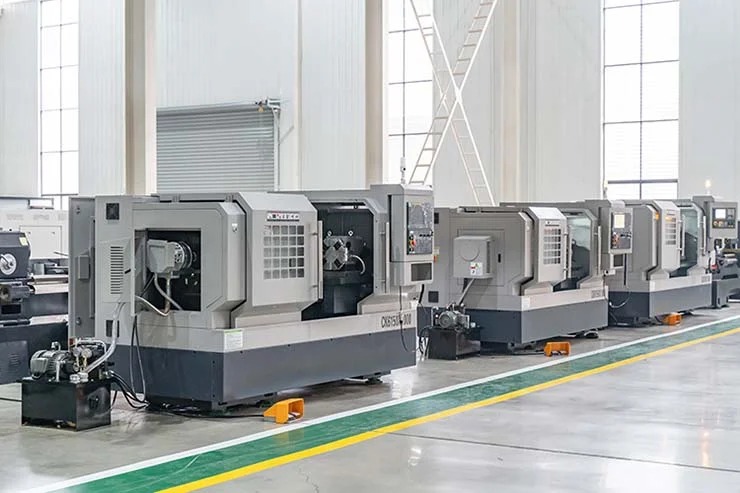
A CNC lathe is a computer-controlled machine tool used to shape rotating workpieces into precise cylindrical forms. Unlike manual lathes, CNC lathes operate through programmed instructions (G-code), which control spindle speed, tool movement, feed rate, and cutting operations automatically.
During operation, the workpiece rotates while a stationary cutting tool removes material to create the desired shape. CNC lathes are primarily used for turning operations such as facing, threading, drilling, grooving, and knurling.
Because of their automation and accuracy, CNC lathes are capable of producing high-volume, identical parts with minimal variation, making them indispensable in modern manufacturing.
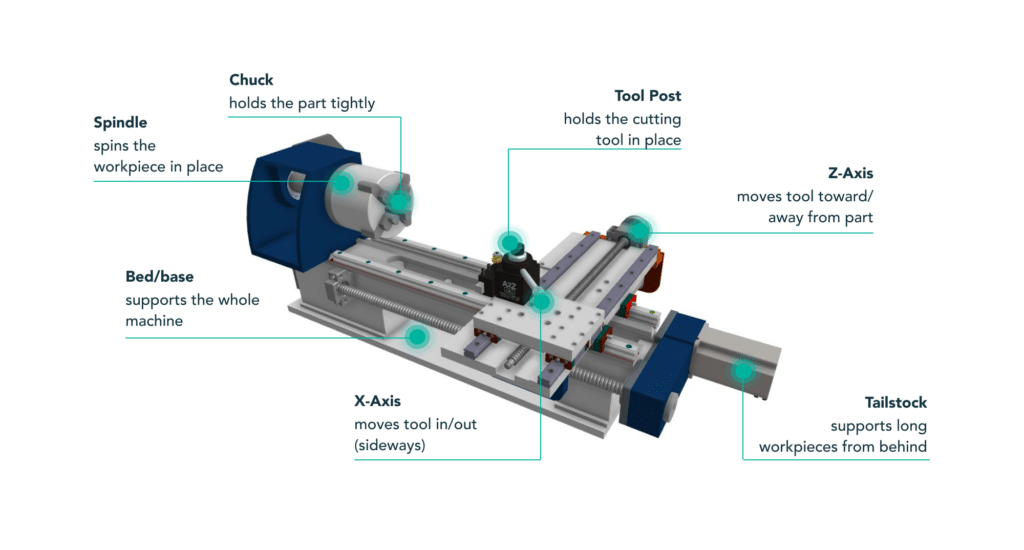
Key Components of a CNC Lathe
The efficiency and precision of a CNC lathe depend on its core components.
1. Spindle
The spindle rotates the workpiece at controlled speeds. Advanced CNC lathes allow variable speed adjustment to match different materials and cutting conditions.
2. Chuck or Collet
This device securely holds the raw material in place. Proper clamping ensures stability and prevents vibration during machining.
3. Tool Turret
The turret holds multiple cutting tools and rotates automatically to switch between operations, reducing setup time and improving efficiency.
4. Machine Bed
The bed provides structural support and rigidity, minimizing vibrations and ensuring dimensional accuracy.
5. Control Panel (CNC Controller)
The CNC controller interprets G-code programs and directs machine movements with high precision.
Types of CNC Lathe Machines
Different manufacturing needs require different types of CNC lathe machines.
1. 2-Axis CNC Lathe
This is the most basic type, capable of performing turning and facing operations along the X and Z axes. It is suitable for simple cylindrical parts.
2. Multi-Axis CNC Lathe
Multi-axis machines include additional axes, allowing more complex geometries to be produced in a single setup. These machines improve efficiency and reduce repositioning errors.
3. CNC Turning Center
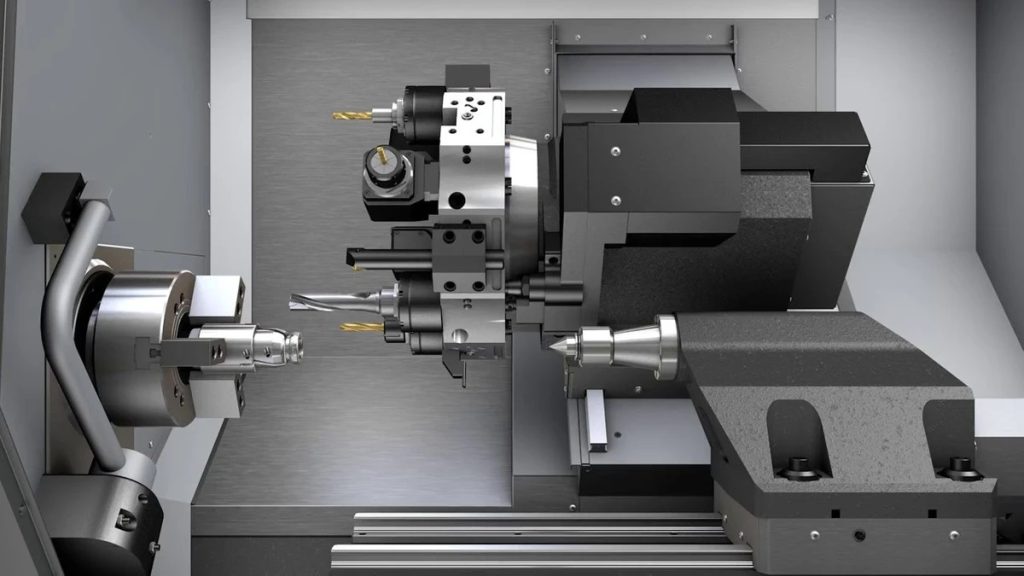
A turning center is an advanced version of a CNC lathe that includes live tooling capabilities. It can perform milling and drilling operations without transferring the part to another machine.
4. Swiss-Type CNC Lathe
Swiss lathes are designed for high-precision, small-diameter components. They are widely used in medical and electronics industries where accuracy is critical.
Materials Used in CNC Lathe Machining
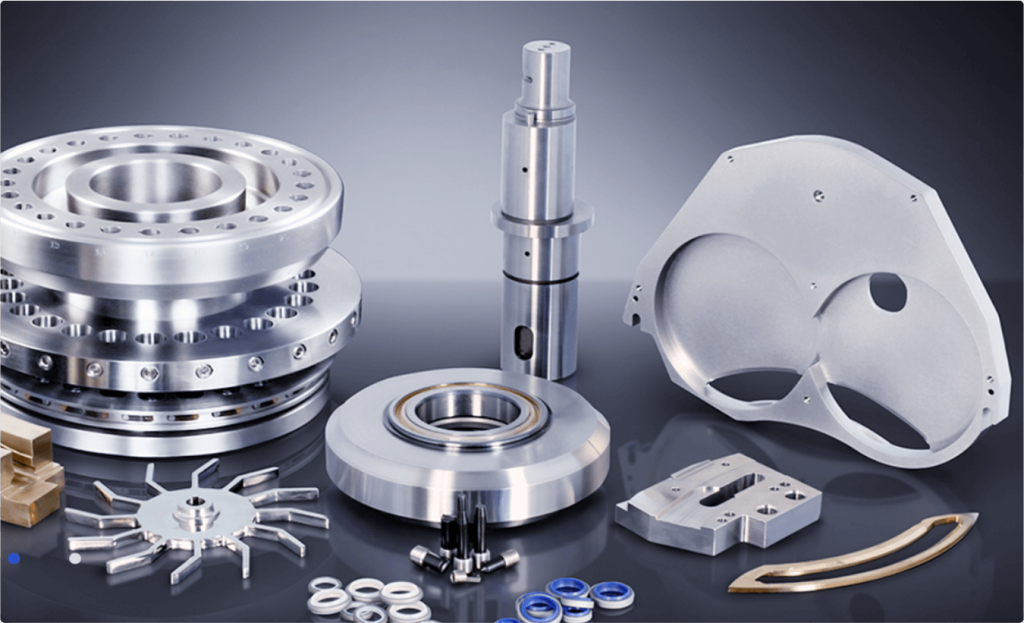
One of the key strengths of CNC lathe machining is its versatility in handling various materials.
Metals
- Aluminum (lightweight and corrosion-resistant)
- Stainless steel (strong and durable)
- Carbon steel (cost-effective and versatile)
- Brass and copper (good conductivity and machinability)
- Titanium (high strength-to-weight ratio)
Plastics
- Nylon
- ABS
- PVC
- Polycarbonate
- PEEK
High-Performance Alloys
- Inconel
- Tool steel
- Aerospace-grade alloys
Material selection depends on application requirements such as strength, heat resistance, corrosion resistance, and cost.
The CNC Lathe Process: Step-by-Step Overview
1. CAD Design
Engineers create a digital 3D model of the component using CAD software, specifying dimensions and tolerances.
2. CAM Programming
The design is converted into G-code using CAM software, which defines tool paths, speeds, and cutting parameters.
3. Machine Setup
The operator mounts the raw material into the chuck and installs the required cutting tools in the turret.
4. Machining Operation
The spindle rotates the workpiece while cutting tools remove material. Operations may include turning, drilling, threading, and finishing.
5. Inspection and Finishing
Finished components are inspected using precision measuring instruments such as micrometers or CMM machines. Surface finishing may be applied if required.
Advantages of CNC Lathe Machines
1. High Precision
CNC lathes can achieve tight tolerances required in aerospace and medical applications.
2. Repeatability
Once programmed, identical components can be produced consistently in large quantities.
3. Increased Productivity
Automation significantly reduces manual labor and production time.
4. Reduced Human Error
Computer-controlled systems minimize variability and operational mistakes.
5. Complex Part Manufacturing
Multi-axis CNC lathes can produce intricate geometries in a single setup.
Applications of CNC Lathe Across Industries
- Automotive Industry
Manufactures shafts, pistons, bushings, brake components, and engine parts.
- Aerospace Industry
Produces precision turbine shafts, fittings, and structural components.
- Medical Industry
Creates surgical instruments, implants, and precision medical devices.
- Oil & Gas Industry
Manufactures threaded fittings, valves, and pressure-resistant components.
- Electronics Industry
Produces connectors, housings, and miniature precision parts.
Modern Advancements in CNC Lathe Technology
1. Multi-Axis CNC Lathes
Modern machines now support additional axes for complex geometries and reduced setups.
2. Live Tooling Integration
Combines turning and milling in a single machine, improving efficiency.
3. Automation and Robotics
Robotic arms and bar feeders increase production speed and reduce downtime.
4. Smart Monitoring and IoT
Real-time performance tracking improves predictive maintenance and operational efficiency.
5. Energy-Efficient Systems
Modern CNC lathes are designed to reduce power consumption and support sustainable manufacturing.
Conclusion: The Continued Importance of CNC Lathe Machines
CNC lathe machines remain a critical component of modern industrial production. Their ability to combine automation, precision, and efficiency ensures their continued relevance across diverse industries.
As smart manufacturing, robotics, and digital integration continue to evolve, CNC lathe technology is becoming even more powerful. From automotive components to aerospace hardware, CNC lathes continue to drive innovation and industrial excellence worldwide.